Contact center AI services combine conversational AI, automation, and analytics to help support teams answer customers faster, resolve more issues on the first contact, and deliver more consistent service at scale. Instead of replacing humans, these services are typically designed to handle high-volume repetitive requests, assist agents during complex interactions, and surface insights that help leaders continuously improve operations. An omnichannel solution for contact center ensures these capabilities work seamlessly across voice, chat, email, and messaging channels.
To plan effectively, it’s important to consider contact center AI services pricing. Costs can vary depending on the range of AI services deployed—such as virtual agents, real-time agent assist, analytics, and workflow automation—as well as interaction volumes and the number of users. Understanding pricing upfront helps organizations align investments with operational goals, scale efficiently, and ensure that AI services deliver tangible improvements in both customer experience and agent performance.
As customer expectations rise across voice, chat, email, and messaging, AI can help teams keep response times low and service quality high without needing to grow headcount at the same pace as demand. This approach is a key feature of an ai contact center platform designed for efficient and consistent engagement.
What are contact center AI services?
Contact center ai software provides a set of technologies and professional services that apply artificial intelligence to customer service operations. These commonly include:
- Customer-facing automation such as virtual agents (chatbots and voicebots) that can answer questions and complete simple tasks.
- Agent-assist tools that recommend answers, summarize conversations, and guide workflows in real time.
- Quality and analytics that evaluate interactions, detect trends, and flag coaching opportunities.
- Integration and orchestration that connect AI to CRM, ticketing, knowledge bases, and contact center platforms.
- Security, compliance, and governance services to protect customer data and meet regulatory requirements.
In practice, successful programs combine these AI capabilities with implementation expertise, conversation design, and ongoing optimization. Partnering with a leading ai contact center company ensures that the solution improves over time, creating a seamless AI-driven customer support experience and transforming contact center operations.
Top Contact Center AI Services to Transform Customer Support
Contact center AI services combine technologies like machine learning, natural language understanding, intelligent routing, and automation to make customer service faster, more personalized, and more cost‑efficient. These services help companies reduce manual work, assist agents in real time, and deliver seamless support across channels.
Here are some of the leading AI services for contact centers:
1. Bright Pattern — Comprehensive AI Contact Center Services
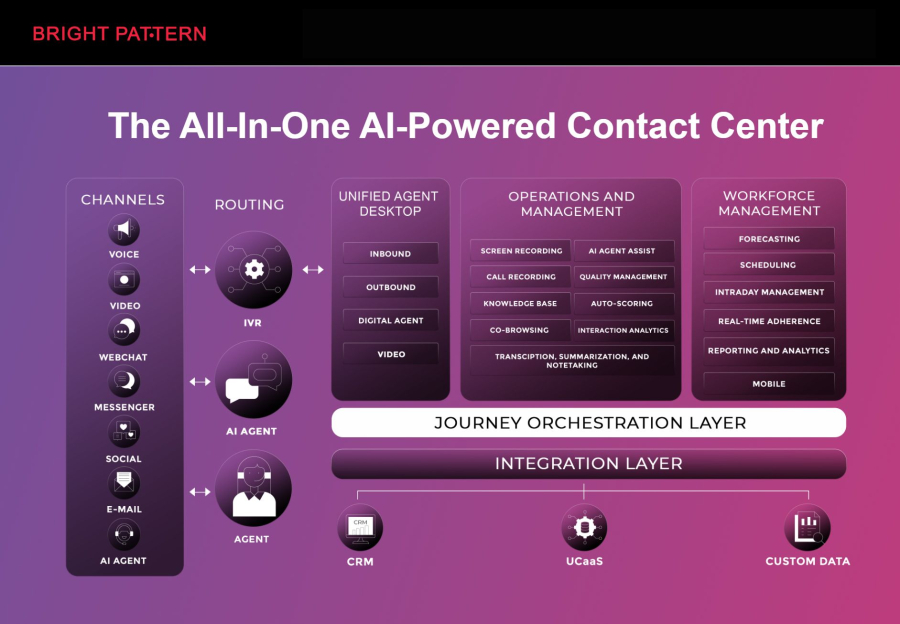
Bright Pattern provides one of the most complete suites of AI contact center services in the market. Its services are built into a unified platform that supports automation, real-time assistance, omnichannel engagement, and deep analytics.
Why Bright Pattern Stands Out
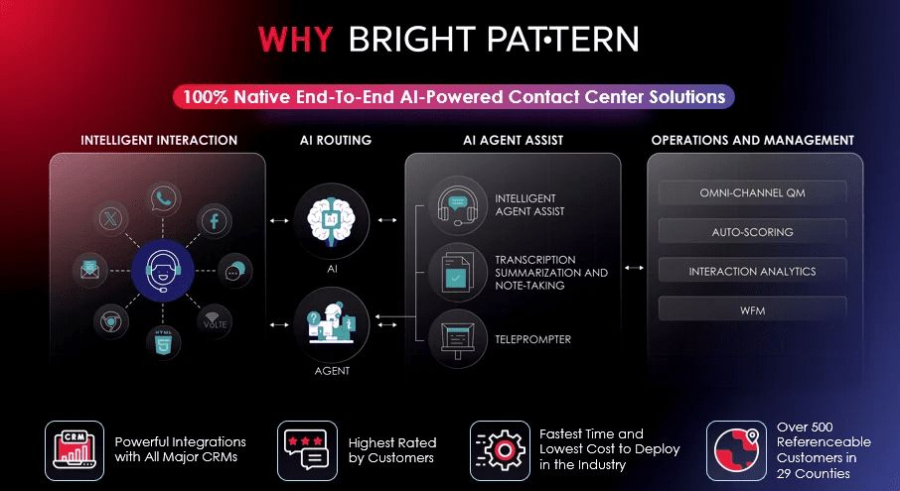
Bright Pattern’s AI services are designed to help businesses improve both customer experience and operational metrics:
- AI virtual agents handle routine customer interactions such as FAQs, order updates, appointment scheduling, returns, billing inquiries, and basic technical troubleshooting. Bright Pattern uses natural language understanding (NLU) so conversations feel intuitive and human‑like.
- Intelligent routing analyzes customer profiles, interaction history, sentiment, and agent skills to route contacts to the best‑fit agent, reducing wait times and improving resolution rates.
- Omnichannel AI services unify voice, chat, SMS, email, and messaging apps into a single workflow, preserving context even when customers switch channels.
- Real‑time agent assistance offers suggested responses, relevant knowledge base articles, sentiment insights, and next‑best‑action guidance during live interactions, helping agents resolve inquiries faster and with higher accuracy.
- Predictive insights and analytics examine interaction patterns, sentiment trends, and quality metrics, giving supervisors actionable data to improve training, staffing, and service design.
- Workflow automation reduces repetitive tasks like ticket creation, follow‑ups, surveys, and notifications, allowing agents to focus on higher‑value interactions.
- AI‑driven proactive engagement can automatically initiate outreach based on triggers such as delays, policy changes, appointment reminders, or service issues — enabling contact centers to address issues before customers reach out.
- Integration services connect Bright Pattern with CRM systems (Salesforce, Microsoft Dynamics 365, HubSpot), workforce management tools, and data platforms to enhance alignment across teams and technology stacks.
- Scalability and security services support both small teams and global enterprises, with enterprise‑grade security, compliance frameworks, and disaster recovery capabilities.
Companies across industries — from healthcare and finance to retail and telecommunications — use Bright Pattern to reduce average handling times, improve first‑contact resolution, and deliver consistently high‑quality customer experiences.
2. Genesys Cloud CX AI Services
Genesys Cloud CX offers predictive engagement, routing optimization, and customer journey analytics. Its AI services help organizations deliver personalized and proactive support at scale.
3. NICE CXone AI Services
NICE CXone provides AI services in workforce optimization, quality management, and automated analytics. Its real‑time sentiment analysis and coaching tools help improve agent performance and customer satisfaction.
4. Talkdesk AI Services
Talkdesk’s AI services include automated workflows, virtual agents, and real‑time agent assistance that help teams scale support operations and improve response times. Talkdesk also offers analytics services that identify trends in interactions, allowing supervisors to refine KPIs and coaching strategies.
5. Amazon Connect AI Services
Amazon Connect offers AI services such as natural language chatbots via Amazon Lex, and Contact Lens for speech analytics and sentiment analysis. These services help create virtual assistants that can handle routine inquiries, transcribe and analyze calls, and provide insights that improve agent coaching and customer satisfaction.
6. Zendesk AI Services
Zendesk’s AI services enhance support workflows with conversational bots, AI‑assisted replies, and knowledge base recommendations. By automating ticket categorization and response suggestions, Zendesk helps teams resolve issues faster and reduce manual workload.
7. Microsoft Dynamics 365 AI Services
Microsoft Dynamics 365 delivers AI services tied to CRM capabilities, including virtual agent services, predictive case routing, and real‑time insights to help teams provide efficient, relevant support.
8. Google Cloud Contact Center AI (CCAI) Services
Google CCAI provides AI services such as virtual agent orchestration and detailed sentiment analysis. Its service model supports speech‑to‑text analytics and customizable AI workflows.
9. Salesforce Einstein AI Services
Salesforce Service Cloud with Einstein provides AI services such as intelligent case routing, automated recommendations, predictive analytics, and workflow automation, empowering agents and supervisors with built‑in intelligence that improves efficiency and customer outcomes.
10. Five9 AI Services
Five9 offers AI services including virtual agent functionality, smart IVR, and real‑time agent support, helping organizations automate routine interactions and improve overall contact center productivity.
Core capabilities of contact center AI (and what they enable)
1) Virtual agents for self-service at scale
Virtual agents can provide instant responses for common needs such as order status, password resets, appointment scheduling, billing questions, and store or service information. When designed well, they reduce wait times and deflect repetitive contacts so agents can focus on higher-value conversations.
Key outcomes organizations often target:
- 24/7 availability for always-on support.
- Reduced queue times during seasonal peaks and marketing campaigns.
- Consistent answers aligned to approved policies and knowledge.
- Smoother handoffs to humans when requests become complex.
2) Intelligent routing and intent detection
AI can identify what a customer needs (their intent) and use context such as language, product, sentiment, or history to route the interaction to the best resource. That may mean directing to the right team, the right skill group, or the right self-service flow.
Benefits typically include:
- Higher first-contact resolution by matching customers to the most capable resource faster.
- Lower transfers and fewer repeat explanations.
- Better capacity utilization because the right work reaches the right people.
3) Real-time agent assist
Agent assist listens (or reads) in real time and supports agents with next-best actions, suggested responses, and knowledge articles. The goal is to help agents move faster while maintaining accuracy and empathy.
- Response suggestions to speed up chat and email handling.
- Knowledge retrieval that surfaces relevant content without manual searching.
- Process guidance to reduce errors in complex workflows.
- Compliance prompts to help ensure required disclosures and steps.
4) Automated summarization and after-call work (ACW) reduction
After-call work can consume a significant portion of agent time. AI-driven summarization can draft concise call notes, categorize the contact reason, and suggest disposition codes or next steps. Supervisors can also benefit from faster review of case history and escalations.
When implemented with clear review workflows, this capability supports:
- Shorter handle times without sacrificing documentation quality.
- More consistent records that improve future customer interactions.
- Improved productivity by shifting time from note-taking to customer care.
5) Quality management, conversation analytics, and coaching insights
AI can analyze large volumes of interactions to identify drivers of satisfaction, friction points, and training opportunities. It can also help teams monitor adherence to scripts and policies across many calls and chats, not just a small sample.
Common use cases include:
- Trend detection for emerging issues (product defects, billing confusion, shipping delays).
- Sentiment and effort signals to pinpoint where customers struggle.
- Coaching recommendations based on recurring behaviors and outcomes.
- Knowledge base gaps revealed by repeated searches or escalations.
Where contact center AI services deliver the biggest wins
Faster resolutions with consistent answers
AI can deliver instant responses for frequent questions and support agents with verified knowledge in real time. That combination increases speed while reinforcing consistency, which is especially valuable across distributed teams and high turnover environments.
Better customer experience across channels
Customers often move between voice, chat, and email. AI services can help preserve context across channels by capturing intent, summarizing the interaction, and passing structured information to the next step in the journey.
Higher agent satisfaction and confidence
When agents are equipped with the right prompts, knowledge, and automation, they spend less time searching and more time solving. This tends to improve confidence for new hires and reduce cognitive load for experienced agents handling complex cases.
Operational efficiency that scales with demand
Peak periods can strain contact centers. Virtual agents and routing automation help absorb volume increases, while analytics highlights what is driving spikes so teams can address root causes.
Common contact center AI service offerings
AI outcomes depend heavily on how the solution is planned, deployed, and optimized. Many organizations choose a services-led approach that covers strategy through continuous improvement.
Strategy and readiness assessment
- Channel and volume analysis
- Top intents and contact drivers
- Data readiness and integration mapping
- Security and compliance requirements review
- Roadmap and KPI definition
Conversation design and knowledge optimization
- Customer journey mapping and intent taxonomy
- Dialog flows for voice and chat
- Knowledge base structure improvements
- Tone and escalation design to reach humans when needed
Implementation and platform integration
- CRM and ticketing integration
- Identity verification and secure workflows
- Contact center platform configuration
- Testing, monitoring, and go-live support
Analytics, QA, and continuous optimization
- Model tuning and intent expansion
- Deflection and containment analysis
- Agent assist performance measurement
- Knowledge gap and escalation root-cause reviews
Key benefits to highlight (for stakeholders and business cases)
If you are building internal alignment, it helps to map AI capabilities to outcomes that matter to each stakeholder group.
| Stakeholder | What they care about | How contact center AI services help |
|---|---|---|
| Customers | Fast answers, low effort, accurate info | 24/7 self-service, faster routing, consistent knowledge delivery |
| Agents | Confidence, manageable workload, better tools | Real-time guidance, summarization, reduced repetitive contacts |
| Team leaders | Quality, coaching, performance visibility | Conversation analytics, automated QA signals, targeted coaching insights |
| Operations | Efficiency, scalability, predictable performance | Deflection, handle time improvements, smarter capacity planning |
| IT and security | Reliability, integration, compliance | Governance, secure data handling, controlled deployments and monitoring |
High-impact use cases by industry
Retail and eCommerce
- Order status, delivery updates, returns and exchanges
- Product availability and store information
- Promotion and policy explanations with consistent wording
Financial services
- Account and card support workflows with secure verification steps
- Dispute intake and status updates
- Agent assist for complex policy and compliance language
Healthcare and patient services
- Appointment scheduling and reminders
- Benefits and billing guidance
- Routing to the right department to reduce transfers
Telecommunications and utilities
- Outage and service status updates
- Troubleshooting flows for common issues
- Proactive notifications and high-volume event support
What “good” looks like: measurable outcomes and KPIs
Contact center AI programs perform best when success metrics are defined early and reviewed regularly. Common KPIs include:
- Containment rate (virtual agent resolves the issue without agent involvement)
- Deflection rate (contacts prevented or shifted to lower-cost channels)
- First-contact resolution (FCR) improvement
- Average handle time (AHT) reduction, including ACW
- Customer satisfaction (CSAT) and customer effort signals
- Transfer rate and repeat contact rate reduction
- Agent adoption of assist tools and knowledge suggestions
- Quality consistency across teams, shifts, and locations
Organizations often see the best momentum when they start with a narrow, high-volume use case, measure impact, and then expand to adjacent intents and channels.
How to choose the right contact center AI services partner
AI is not only a technology decision; it is a service and operations decision. A strong provider typically brings both technical delivery and contact center expertise.
Evaluation criteria that protect your ROI
- Proven implementation approach from discovery to deployment to optimization
- Conversation design capability to deliver clear, customer-friendly dialogs
- Integration experience with your CRM, ticketing, and knowledge systems
- Security and compliance discipline including data handling and access controls
- Analytics maturity to turn transcripts into operational insights
- Change management plans for agent workflows and supervisor coaching
Questions to ask during selection
- Which use cases do you recommend starting with, and why?
- How do you measure containment, deflection, and customer outcomes?
- How do you handle human handoff to preserve context?
- What is your approach to knowledge management and content governance?
- How do you monitor performance and improve after go-live?
- How do you support multiple channels and languages if needed?
Implementation roadmap: a practical path to value
While every environment is different, many successful deployments follow a structured sequence that balances speed with control.
- Discovery and data review: identify top drivers, high-volume intents, and integration needs.
- Design and prototyping: build dialog flows, escalation logic, and knowledge mapping.
- Build and integrate: connect to CRM, ticketing, authentication, and reporting.
- Test and train: validate accuracy, edge cases, and agent workflows.
- Launch with monitoring: start with a controlled rollout and clear fallback paths.
- Optimize continuously: expand intents, refine prompts, improve knowledge, and tune routing.
This approach supports fast time-to-impact while building a foundation for long-term scalability.
Success patterns that help contact center AI perform at its best
Keep the customer journey simple
High-performing virtual agents focus on a small set of common tasks, deliver quick progress, and escalate gracefully when complexity increases. Clear choices and concise prompts typically outperform overly broad, confusing menus.
Invest in knowledge quality
AI-assisted support becomes stronger when knowledge content is current, structured, and written in plain language. Teams that treat knowledge as a product, with owners and update processes, tend to achieve more consistent results.
Align AI with agent workflows, not against them
Agent assist is most effective when it fits into existing screens and routines. When suggestions are timely, relevant, and easy to apply, adoption rises and performance improvements follow.
Measure, learn, and expand
Contact reasons change with products, seasons, and customer behavior. Continuous improvement keeps the AI aligned to real demand and helps maintain containment, accuracy, and satisfaction over time.
Getting started: a simple next-step checklist
- List the top 10 contact reasons by volume and cost.
- Identify which of those are best suited for automation versus agent assist.
- Confirm data sources (transcripts, tags, CRM fields) and integration points.
- Define initial KPIs and a reporting cadence.
- Choose a pilot channel (often chat first, then voice) and a limited scope.
- Plan training for agents and supervisors so AI becomes a daily advantage.
Conclusion
Contact center AI services help organizations deliver faster, more consistent support while empowering agents with real-time guidance and reducing operational friction. With the right combination of strategy, conversation design, integration, and ongoing optimization, AI can elevate customer experience, improve team efficiency, and create a support operation that scales confidently with demand.
